
Cloud Cost vs. Cloud Security: Why Misconfiguration Is Both a Financial and Cyber Risk
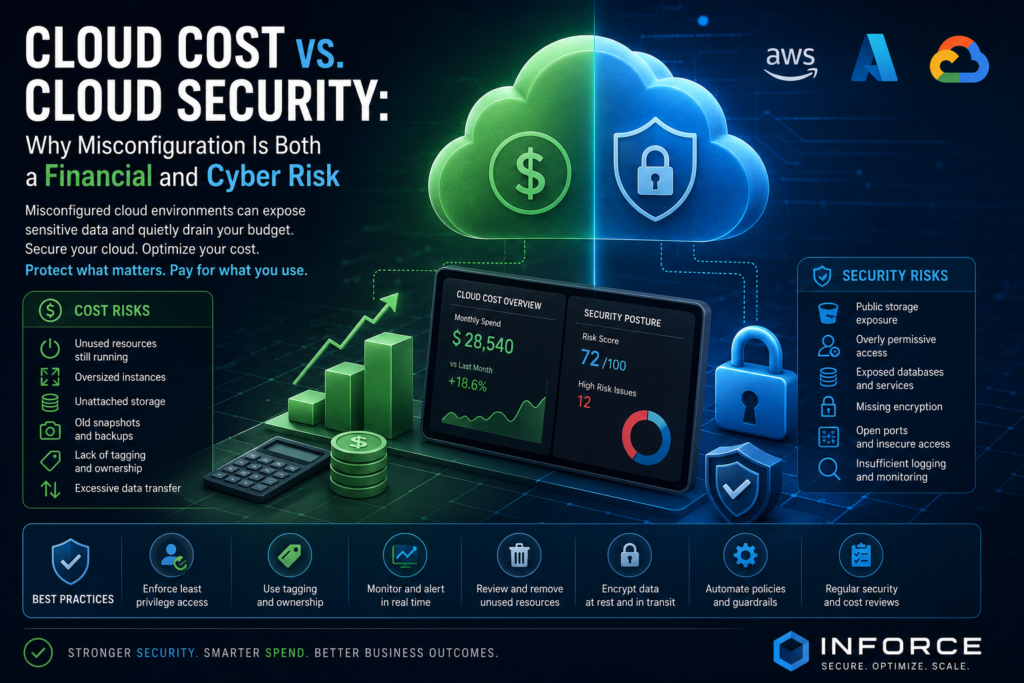
Cloud platforms help businesses move faster.
They make it easier to launch new products, scale infrastructure, support remote teams, store data, deploy applications, and connect services across different environments. For startups, growing companies, and enterprise teams, the cloud offers flexibility that traditional infrastructure often cannot match.
But cloud flexibility also creates complexity.
New servers, storage buckets, databases, permissions, APIs, users, containers, and services can be created quickly. Teams can experiment, deploy, and scale without waiting for long infrastructure approval cycles. This speed is useful, but it also increases the risk of misconfiguration.
A small cloud configuration mistake can expose sensitive data. It can allow unauthorized access. It can create unnecessary costs. It can leave unused resources running for months. It can make audits more difficult. It can also create hidden weaknesses that attackers may discover before the business does.
Cloud misconfiguration is often treated as a cybersecurity issue. It is that — but it is also a financial risk.
A poorly configured cloud environment can be both unsafe and expensive.
For modern businesses, cloud security and cloud cost control should not be separate conversations. They are connected parts of the same operational challenge: building cloud environments that are secure, efficient, scalable, and easy to manage.
Why Cloud Growth Creates Hidden Complexity
Cloud environments rarely stay simple for long.
A company may start with a few virtual machines, one database, and a storage service. Over time, it adds new applications, development environments, analytics tools, backup systems, monitoring tools, integrations, containers, serverless functions, and user roles.
Different teams may create resources for different purposes. Developers may deploy test environments. Marketing teams may use cloud-based tools. Operations teams may configure backups. Security teams may add monitoring. External vendors may receive access for support.
Without clear governance, cloud environments can become difficult to track.
This creates questions such as:
Which resources are still being used?
Who owns each environment?
Which systems contain sensitive data?
Which services are exposed to the internet?
Who has administrative access?
Are permissions too broad?
Are unused resources still generating costs?
Are backups configured properly?
Are logs being collected?
Are development and production environments separated?
When businesses cannot answer these questions clearly, both security and cost risks increase.
What Is Cloud Misconfiguration?
Cloud misconfiguration happens when a cloud service, resource, permission, or security setting is not configured correctly for its intended purpose.
This does not always mean someone made a major technical mistake. Many misconfigurations happen because cloud platforms are complex, settings change often, teams move quickly, and default configurations may not match business security needs.
Common examples include:
- Public storage buckets
- Overly permissive access rights
- Exposed databases
- Open network ports
- Weak identity and access management policies
- Missing encryption
- Poor separation between development and production environments
- Incomplete logging and monitoring
- Unused but active cloud resources
- Unrestricted API access
- Misconfigured backups
- Lack of tagging or ownership labels
- Excessive administrator privileges
- Forgotten test environments
- Insecure third-party integrations
Some of these issues create direct security exposure. Others create unnecessary cost. Many create both.
How Misconfiguration Becomes a Security Risk
The cloud is secure when it is configured and managed correctly. But cloud providers and customers share responsibility. Providers secure the underlying cloud infrastructure, while customers are responsible for configuring their own services, access, data, and workloads properly.
That means a business can use a secure cloud platform and still create risk through poor configuration.
For example, a storage bucket may accidentally be made public. A database may be accessible from the internet. A user may receive more permissions than needed. Logging may be disabled, making suspicious activity harder to detect. A development environment may contain real customer data without proper protection.
Attackers actively look for these weaknesses.
Cloud misconfiguration can lead to:
- Data exposure
- Unauthorized access
- Account compromise
- Service disruption
- Compliance issues
- Lateral movement across systems
- Abuse of cloud resources
- Loss of customer trust
- Incident response complexity
Even one small misconfiguration can become a serious business problem if it exposes sensitive information or provides an entry point into the environment.
How Misconfiguration Creates Unnecessary Cloud Costs
Cloud misconfiguration is not only about security. It can also quietly increase monthly bills.
Cloud pricing is usage-based. This means unused, oversized, duplicated, or poorly managed resources continue to generate costs as long as they remain active.
Common cost-related misconfigurations include:
- Unused virtual machines still running
- Oversized compute resources
- Old development or testing environments
- Unattached storage volumes
- Unused snapshots and backups
- Excessive data transfer
- Inefficient database configurations
- Overprovisioned storage
- Duplicate monitoring or logging services
- Resources without ownership tags
- Poor scaling rules
- Forgotten temporary infrastructure
These issues may not trigger security alerts, but they directly affect the business.
A company may pay for resources no one uses. It may store unnecessary data for months or years. It may run environments outside working hours when they are not needed. It may lose visibility into which department or project is responsible for cloud spending.
Over time, these small inefficiencies can become significant.
Cloud cost optimization is not only a finance task. It requires technical visibility, ownership, governance, and regular review.
The Connection Between Security and Cost
Security and cost risks often come from the same root problem: lack of visibility.
If a business does not know which cloud assets exist, it cannot secure them properly. It also cannot manage their cost effectively.
For example:
A forgotten test server may be unpatched and exposed to attackers. It may also continue generating monthly charges.
An untagged storage bucket may contain sensitive data without clear ownership. It may also accumulate unnecessary storage costs.
Overly permissive access policies may increase breach risk. They may also allow users or services to create expensive resources without proper approval.
Missing monitoring may make attacks harder to detect. It may also make unusual usage spikes harder to notice.
Poor environment separation may expose production data. It may also create duplicated or inefficient infrastructure.
In cloud environments, good security hygiene often supports good cost management. The same practices that reduce cyber risk can also improve financial efficiency.
Why Access Control Matters
Identity and access management is one of the most important parts of cloud security.
Every user, service, application, and integration should have only the access it needs to perform its role. This is known as the principle of least privilege.
When permissions are too broad, the risk increases. A compromised account with excessive permissions can cause much more damage than a limited account. A developer account with unnecessary admin rights may accidentally change critical settings. A third-party integration may access more data than required.
Access control also affects cost.
If too many users can create resources freely, cloud environments may grow without proper oversight. Temporary systems may become permanent. Test environments may remain active. Expensive services may be deployed without budget awareness.
Strong access control helps prevent both unauthorized activity and uncontrolled cloud spending.
Businesses should regularly review:
- Administrator accounts
- User permissions
- Service accounts
- Third-party access
- API keys and secrets
- Role assignments
- Privileged actions
- Inactive users
- Access to sensitive data
- Resource creation rights
Access should be intentional, documented, and reviewed regularly.
Why Tagging and Ownership Are Important
Cloud tagging may seem simple, but it is essential for both security and cost control.
Tags help identify who owns a resource, what project it belongs to, whether it is production or development, what data classification it has, and whether it is still needed.
Without tagging, cloud environments become harder to manage.
A business may find resources but not know who created them. Security teams may not know whether a system is critical. Finance teams may not know which department is responsible for spending. Operations teams may not know whether a server can be shut down.
Useful tags may include:
- Owner
- Department
- Project
- Environment
- Data sensitivity
- Cost center
- Business criticality
- Expiration date
- Compliance scope
Tagging supports accountability. It helps teams understand what exists, why it exists, who is responsible for it, and how it should be protected.
Monitoring Helps Detect Risk and Waste
Cloud monitoring is important for both security and cost management.
Security monitoring helps detect suspicious activity, unauthorized access, configuration changes, unusual data movement, and risky behavior.
Cost monitoring helps detect spending spikes, unused resources, inefficient usage, and unexpected consumption.
Together, they provide a clearer picture of the cloud environment.
For example, a sudden increase in compute usage may indicate a legitimate traffic spike, a misconfigured scaling rule, or abuse of cloud resources by an attacker. A large data transfer may be normal business activity, or it may signal data exfiltration. A new public-facing resource may be part of a planned deployment, or it may be an accidental exposure.
Monitoring helps teams investigate quickly and respond before the issue becomes more serious.
Businesses should monitor:
- Resource usage
- Configuration changes
- Access events
- Network exposure
- Data transfers
- Privileged actions
- Cost trends
- Budget alerts
- Security alerts
- Logging status
- Backup activity
- Unusual behavior
Without monitoring, businesses may discover problems only after damage has already happened.
Development and Production Environments Must Be Separated
One common mistake is poor separation between development, testing, and production environments.
Development environments are often more flexible. Teams may test new features, use temporary credentials, enable debugging, or experiment with configurations. Production environments, on the other hand, require stricter security, stability, monitoring, and access control.
When these environments are not properly separated, risk increases.
Problems may include:
- Real customer data used in testing
- Developers with unnecessary production access
- Test systems connected to production databases
- Weak controls in non-production environments
- Public exposure of development tools
- Inconsistent logging and monitoring
- Configuration mistakes copied into production
Separation also helps cost management.
Development and testing environments may not need to run continuously. They can often be scheduled to shut down outside working hours. They may use smaller resources than production. They may also have expiration policies to avoid forgotten infrastructure.
Clear environment separation improves security, stability, and efficiency.
Backups and Storage Need Regular Review
Backups are essential for resilience, but they can also create risk and cost problems if they are not managed properly.
Poorly configured backups may fail when needed. They may store sensitive data without encryption. They may be accessible to too many users. They may be retained longer than necessary. They may also create significant storage costs over time.
Businesses should review:
- What data is backed up
- How often backups are created
- Where backups are stored
- Whether backups are encrypted
- Who can access backups
- How long backups are retained
- Whether restore tests are performed
- Whether old snapshots are still needed
- Whether backup costs are increasing unnecessarily
Backup strategy should support both security and business continuity. But it should also be managed carefully to avoid unnecessary exposure and cost.
Regular Cloud Reviews Reduce Risk
Cloud environments change constantly, so one-time configuration is not enough.
Regular cloud reviews help identify security gaps, cost inefficiencies, and governance issues before they become bigger problems.
A cloud review may include:
- Asset inventory
- Access review
- Public exposure check
- Configuration assessment
- Storage and backup review
- Logging and monitoring validation
- Cost analysis
- Tagging and ownership review
- Vulnerability review
- Compliance check
- Architecture review
- Recommendations for optimization
These reviews help businesses understand where they stand and what should be improved.
They also help align cloud usage with business goals. The objective is not simply to reduce cost or lock everything down. The objective is to create a cloud environment that is secure, efficient, scalable, and suitable for the organization’s needs.
Building a Secure and Optimized Cloud Environment
A secure and optimized cloud environment requires the right balance of governance, automation, monitoring, and technical design.
Businesses should focus on:
- Clear ownership of cloud resources
- Strong identity and access management
- Least privilege permissions
- Secure network configurations
- Encryption for sensitive data
- Proper logging and monitoring
- Regular vulnerability and configuration checks
- Cost visibility and budget alerts
- Tagging standards
- Environment separation
- Automated policy enforcement where possible
- Regular cleanup of unused resources
- Backup and recovery validation
These practices support security and cost control at the same time.
The most successful organizations treat cloud management as an ongoing process, not a one-time setup.
How INFORCE Helps Businesses Improve Cloud Security and Efficiency
INFORCE helps businesses design, build, review, and improve digital environments with security and performance in mind.
For organizations using cloud platforms, INFORCE can help identify misconfigurations, reduce unnecessary risk, improve access control, review infrastructure, and support better cloud governance. This helps businesses protect sensitive data, reduce exposure, improve reliability, and avoid avoidable cloud costs.
INFORCE also supports companies through software development, web development, mobile applications, cybersecurity, and security testing. This means cloud security can be considered not only after deployment, but throughout the full digital product lifecycle.
Whether a business is launching a new platform, scaling an existing application, reviewing its cloud environment, or preparing for stronger cybersecurity controls, INFORCE can provide practical guidance and technical expertise.
The goal is to help businesses build cloud environments that are not only powerful, but also secure, efficient, and ready for growth.
Conclusion
Cloud technology gives businesses speed, flexibility, and scalability. But without proper configuration and governance, it can also create hidden risks and unnecessary costs.
Cloud misconfiguration is both a cybersecurity problem and a financial problem.
The same visibility gaps that expose data can also waste budget. The same weak access controls that increase breach risk can also allow uncontrolled resource creation. The same forgotten systems that generate monthly charges can also become attack targets.
Businesses should not treat cloud security and cloud cost optimization as separate priorities. They should manage them together.
A secure cloud environment is often a more efficient one. An optimized cloud environment is often easier to secure.
With regular reviews, strong access control, proper monitoring, and clear ownership, companies can reduce risk, control costs, and build cloud infrastructure that supports long-term growth.