
Penetration Testing vs. Vulnerability Assessment: What Does Your Business Really Need?
Every business today depends on digital systems.
Websites, mobile applications, internal platforms, cloud services, APIs, customer portals, payment systems, and third-party integrations all help companies operate faster and serve customers better. But every digital system also creates potential security risk.
A single weak password, exposed API endpoint, outdated plugin, misconfigured cloud service, or vulnerable application component can become an entry point for attackers.
This is why security testing is no longer optional. It is an essential part of protecting business operations, customer data, reputation, and long-term growth.
However, many companies know they need “security testing” but are not sure what kind of testing they actually need. Two terms often appear in this conversation: vulnerability assessment and penetration testing.
They are connected, but they are not the same.
Understanding the difference can help your business choose the right approach, avoid unnecessary costs, and build a stronger cybersecurity strategy.
Why Security Testing Matters
Cybersecurity risks are constantly changing. New vulnerabilities are discovered, software becomes outdated, systems are updated, employees change roles, and businesses add new tools or integrations.
A system that was secure six months ago may not be secure today.
Security testing helps organizations identify weaknesses before attackers can exploit them. It gives business leaders and technical teams a clearer understanding of risk and provides practical recommendations for improvement.
Security testing can help answer questions such as:
Is our website exposed to common attacks?
Are our APIs properly protected?
Can unauthorized users access sensitive data?
Are our cloud services configured securely?
Do our applications use vulnerable third-party components?
Could an attacker gain access to internal systems?
Are we prepared for customer, partner, or compliance security requirements?
Without testing, companies often rely on assumptions. With testing, they gain evidence.
What Is a Vulnerability Assessment?
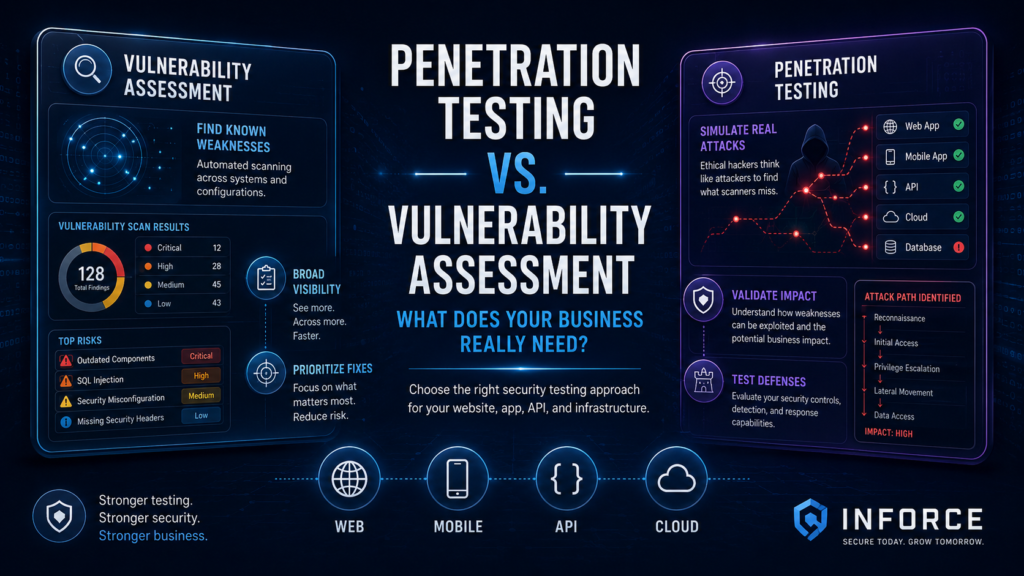
A vulnerability assessment is a structured review designed to identify known security weaknesses in systems, applications, networks, or configurations.
It is often the first step in understanding an organization’s security posture.
During a vulnerability assessment, security specialists use a combination of automated tools and manual review to detect weaknesses such as outdated software, missing patches, insecure settings, exposed services, weak encryption, known application vulnerabilities, and risky configurations.
The goal is to find and prioritize vulnerabilities.
A vulnerability assessment usually answers the question:
“What known weaknesses exist in our environment?”
It does not usually go as deep as a penetration test. Instead of trying to actively exploit vulnerabilities, the focus is on identifying them, ranking their severity, and providing recommendations for remediation.
What Does a Vulnerability Assessment Include?
The scope of a vulnerability assessment depends on the business need, but it may include:
Website vulnerability scanning
Network security review
Server and infrastructure scanning
Cloud configuration checks
Application security review
API vulnerability checks
Dependency and software component analysis
Basic authentication and access control review
Review of exposed services
Patch and version checks
The final report usually includes a list of discovered vulnerabilities, severity ratings, affected systems, business impact, technical details, and recommended fixes.
For many organizations, this is a practical and cost-effective way to understand where the most urgent security gaps are.
When Does Your Business Need a Vulnerability Assessment?
A vulnerability assessment is useful when your business wants a broad overview of security weaknesses.
It is often the right choice when:
You have not tested your systems before
You want to identify common vulnerabilities quickly
You recently launched a new website, application, or platform
You want to check whether systems are properly patched
You need regular security reviews
You are preparing for a more advanced penetration test
You need visibility into external or internal exposure
You want to prioritize remediation work
A vulnerability assessment is especially useful as part of an ongoing cybersecurity program. Regular assessments help ensure that new risks are identified as systems change.
What Is Penetration Testing?
Penetration testing, often called pentesting, is a deeper and more targeted security test.
During a penetration test, security specialists simulate real-world attack techniques to understand whether vulnerabilities can actually be exploited and what impact they could have on the business.
A penetration test usually answers the question:
“What could an attacker actually do if they targeted our systems?”
This makes penetration testing more realistic than a basic vulnerability assessment. The goal is not only to identify weaknesses, but also to validate risk by safely testing how far an attacker could go.
For example, a vulnerability assessment may identify a potentially risky login function. A penetration test may investigate whether that weakness can be used to bypass authentication, access another user’s account, retrieve sensitive data, or escalate privileges.
This deeper approach helps organizations understand the real business impact of security flaws.
What Does Penetration Testing Include?
Penetration testing is usually more manual, more focused, and more detailed than a vulnerability assessment.
Depending on the scope, it may include:
Web application penetration testing
Mobile application penetration testing
API penetration testing
Network penetration testing
Cloud environment testing
Authentication and authorization testing
Business logic testing
Privilege escalation testing
Exploitation of confirmed vulnerabilities
Post-exploitation impact analysis
Security control validation
Detailed remediation guidance
A penetration test can be performed from different perspectives. For example, testers may simulate an external attacker with no internal access, an authenticated user, a malicious insider, or a compromised vendor account.
The exact approach depends on the business objective.
When Does Your Business Need Penetration Testing?
Penetration testing is usually the right choice when your business needs deeper assurance.
It is especially useful when:
You are launching a high-value application or platform
You handle sensitive customer, financial, healthcare, or business data
You need to validate security before going live
You have already completed a vulnerability assessment
You need to test whether controls actually work
You are preparing for compliance, audits, or partner requirements
You want to understand real-world attack scenarios
You recently made major infrastructure or application changes
You want to test incident response and detection capabilities
Penetration testing is also valuable for organizations that need to demonstrate cybersecurity maturity to customers, investors, partners, or regulators.
Vulnerability Assessment vs. Penetration Testing: The Key Differences
Although both services help improve cybersecurity, they serve different purposes.
A vulnerability assessment is broader. It identifies known weaknesses across a defined scope and helps prioritize fixes.
A penetration test is deeper. It explores whether weaknesses can be exploited and what the real impact could be.
A vulnerability assessment is often more automated and checklist-driven, although it can include manual validation. Penetration testing relies more heavily on expert analysis, manual techniques, and attacker-style thinking.
A vulnerability assessment is useful for regular security hygiene. Penetration testing is useful for deeper validation and higher-risk environments.
Both are valuable. The right choice depends on your business goals, risk level, maturity, budget, and timeline.
A Simple Comparison
Here is a practical way to think about the difference:
A vulnerability assessment tells you where the doors and windows may be unlocked.
A penetration test checks whether someone can actually get inside, move around, access valuable information, and cause damage.
Both perspectives matter.
If you only run vulnerability assessments, you may not fully understand the real-world impact of the issues found.
If you only run penetration tests without regular vulnerability assessments, you may miss broader hygiene problems that appear over time.
The strongest cybersecurity programs often use both.
What Should Be Tested?
Businesses often assume that only websites need security testing. In reality, risk can exist across many digital assets.
Security testing may be needed for:
Corporate websites
E-commerce platforms
Web applications
Mobile applications
APIs
Customer portals
Admin dashboards
Cloud infrastructure
Internal networks
Payment flows
CRM and ERP integrations
Authentication systems
Third-party plugins and components
Databases and storage systems
The most important assets to test are the ones that process sensitive data, support critical business operations, or are exposed to the internet.
Website Security Testing
A business website is often the first digital touchpoint with customers. It may include contact forms, login areas, payment functions, content management systems, plugins, tracking tools, and third-party integrations.
Common website security risks include outdated plugins, weak administrator passwords, insecure forms, exposed directories, misconfigured servers, missing security headers, and vulnerable CMS components.
Testing helps ensure that the website is not only visually professional, but also safe and reliable.
Mobile Application Security Testing
Mobile applications introduce unique security challenges.
They may store data on the device, communicate with backend APIs, use third-party SDKs, handle authentication tokens, and operate across different networks.
Mobile app testing can help identify insecure data storage, weak encryption, improper session management, insecure API calls, hardcoded secrets, and risks related to reverse engineering.
For businesses offering mobile apps to customers or employees, security testing is essential before launch and after major updates.
API Security Testing
APIs are one of the most important parts of modern digital systems. They connect applications, services, databases, partners, and users.
But APIs can also expose sensitive data if they are not properly protected.
Common API risks include broken authentication, weak authorization, excessive data exposure, missing rate limits, insecure tokens, poor input validation, and business logic flaws.
API testing is especially important for companies that operate SaaS platforms, mobile apps, e-commerce systems, financial tools, or any product that depends on data exchange between services.
Cloud and Infrastructure Security Testing
Cloud platforms make it easier to scale digital services, but misconfigurations can create serious security exposure.
Common cloud and infrastructure risks include public storage buckets, overly permissive access policies, exposed databases, weak network segmentation, missing logging, unpatched servers, and insecure remote access.
Testing cloud and infrastructure environments helps organizations reduce the risk of data exposure, service disruption, and unauthorized access.
What a Good Security Testing Report Should Include
The value of security testing depends heavily on the quality of the report.
A good report should be clear enough for business leaders and detailed enough for technical teams.
It should include:
Executive summary
Scope of the test
Methodology
Risk ratings
List of findings
Business impact
Technical explanation
Evidence or screenshots where appropriate
Affected systems or components
Recommended remediation steps
Priority order for fixes
Retesting recommendation
The goal is not to create fear. The goal is to provide clarity and a practical path forward.
A strong report should help your team understand what matters most and what to fix first.
How Often Should Security Testing Be Done?
Security testing should not be a one-time activity.
The right frequency depends on the organization, but testing is commonly recommended:
Before launching a new website, app, or platform
After major code changes
After infrastructure or cloud changes
After integrating new third-party services
After a security incident
Before important audits or partner reviews
On a regular schedule, such as quarterly, semi-annually, or annually
High-risk systems should be tested more often, especially if they process sensitive data or are exposed to the internet.
Regular testing helps businesses keep pace with changing threats and evolving systems.
Which Option Does Your Business Really Need?
If your business has never performed security testing before, a vulnerability assessment is often a strong starting point. It provides broad visibility and helps identify the most obvious and urgent weaknesses.
If your business is launching a critical product, handling sensitive data, preparing for compliance, or needing deeper assurance, penetration testing is usually the better choice.
In many cases, the best approach is to combine both:
First, perform a vulnerability assessment to identify and fix common issues.
Then, perform penetration testing to validate security from an attacker’s perspective.
This creates a stronger and more complete view of risk.
How INFORCE Helps Businesses Test and Strengthen Security
INFORCE helps businesses understand, test, and improve the security of their digital systems.
Whether your organization needs a vulnerability assessment, penetration test, website security review, mobile application test, API security assessment, or broader cybersecurity support, INFORCE provides practical guidance tailored to your business goals.
Our approach is focused on clarity, not complexity. We help identify real risks, explain their business impact, and provide actionable recommendations your team can use to improve security.
For companies building new digital products, INFORCE can test security before launch.
For companies with existing systems, we can assess current risks and help prioritize improvements.
For organizations preparing for customer reviews, audits, or compliance requirements, we can provide evidence-based security testing that supports trust and accountability.
Conclusion
Security testing is one of the most practical ways to reduce cyber risk.
A vulnerability assessment helps identify known weaknesses across your environment. A penetration test goes deeper and shows what an attacker may be able to do in practice.
Both approaches are valuable. The right choice depends on your systems, risk level, business goals, and security maturity.
What matters most is not the name of the test. What matters is taking action before attackers find the weaknesses first.
For modern businesses, security testing is not just a technical exercise. It is an investment in trust, resilience, and long-term success.