
Secure by Design: Why Cybersecurity Should Start Before the First Line of Code
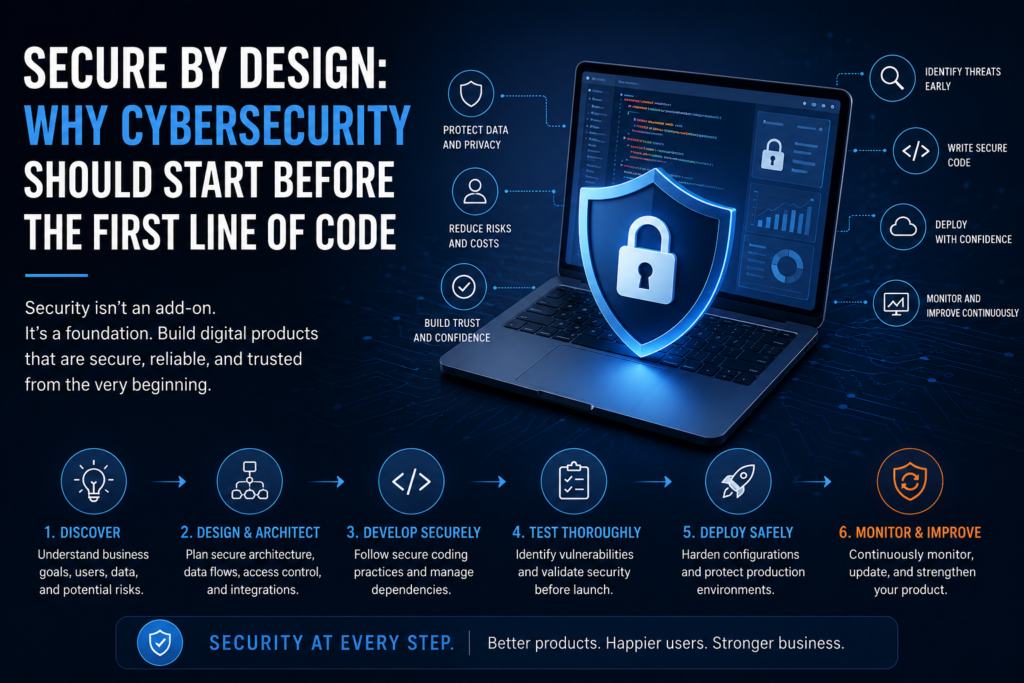
Cybersecurity is often treated as something that happens at the end of a project.
A website is built. A mobile application is developed. A custom platform is launched. Then, just before release — or sometimes after an incident — someone asks the important question: “Is it secure?”
By that point, the answer may be complicated.
Security issues discovered late in the development process are usually harder, slower, and more expensive to fix. A weak architecture may require major changes. Poor access control may affect multiple parts of the system. Insecure data flows may force teams to rethink how information is collected, stored, and processed. Vulnerabilities in third-party components may delay launch or create hidden business risk.
This is why modern digital products should be built with a secure-by-design approach.
Secure by design means cybersecurity is not added as a final layer. It is considered from the beginning — during planning, architecture, design, development, testing, deployment, and ongoing maintenance. It helps organizations create digital products that are not only functional and attractive, but also resilient, trustworthy, and ready for real-world threats.
For businesses investing in software, websites, mobile applications, or digital platforms, security should not be an afterthought. It should be part of the foundation.
What Does “Secure by Design” Mean?
Secure by design is a development approach where security is built into the product from the earliest stages.
Instead of waiting until the end to scan for vulnerabilities, teams think about risks before the first line of code is written. They ask questions such as:
What data will the system collect and process?
Who should have access to this information?
How will users authenticate?
What could go wrong if an account is compromised?
Which third-party services or libraries will be used?
How will sensitive data be protected?
What happens if the system is attacked?
How will the product be monitored after launch?
These questions help teams make better decisions early, when changes are easier to implement.
Secure by design does not mean slowing down innovation. It means reducing avoidable risks before they become expensive problems. It gives businesses the confidence to launch digital products that are stronger, safer, and better prepared for growth.
Why Security Problems Become More Expensive When Found Late
Every project has stages: idea, discovery, design, development, testing, launch, and maintenance. The later a serious security issue is discovered, the more difficult it becomes to fix.
For example, if security is considered during the planning stage, the team can choose the right architecture, authentication model, data protection approach, and access control structure from the start.
If the same issue is discovered after development is complete, the team may need to rewrite core functionality, change database logic, adjust user flows, update APIs, and retest the entire system.
If the issue is discovered after launch, the business may face downtime, emergency fixes, customer concerns, reputational damage, or even regulatory consequences.
This is why security planning is a business decision, not only a technical task.
Building security early helps reduce rework, protect budgets, support compliance, and improve long-term product stability.
Security Starts During Product Discovery
The discovery phase is where the product idea becomes a practical plan. This is the best time to identify potential security and privacy risks.
During discovery, teams should define:
-
What the product will do
-
What types of users it will support
-
What data will be collected
-
Which systems it will connect to
-
What regulations may apply
-
What business risks should be avoided
-
What security expectations users or partners may have
This stage is especially important for products that handle personal data, payments, customer accounts, business information, healthcare data, financial records, or internal company processes.
For example, an e-commerce platform needs secure payment flows and protection against account takeover. A mobile application may need secure authentication and safe local storage. A corporate portal may need role-based access control and strong audit trails. A SaaS platform may need tenant separation, encryption, monitoring, and secure API design.
By identifying these needs early, the team can design a product that is safer from the beginning.
Secure Architecture Creates a Strong Foundation
Architecture decisions affect the entire product.
A secure architecture defines how the system is structured, how components communicate, how data moves, and how access is controlled. If the architecture is weak, even well-written code may not be enough to protect the system.
Important architectural security considerations include:
-
Authentication and authorization
-
User roles and permissions
-
Data encryption
-
Secure API communication
-
Separation of environments
-
Logging and monitoring
-
Backup and recovery
-
Cloud configuration
-
Third-party integrations
-
Scalability and availability
-
Secure administration panels
Good architecture reduces complexity and makes the system easier to protect. It also helps development teams avoid shortcuts that may create vulnerabilities later.
Secure architecture is particularly important for custom software, enterprise platforms, mobile applications, and systems that connect with multiple services or process sensitive information.
Secure Design Improves the User Experience
Security and user experience are sometimes seen as opposites. In reality, good security design can improve the user experience.
Users want products that are easy to use, but they also want to feel safe. They expect their accounts, personal information, and business data to be protected.
Secure design helps create this trust.
For example, a well-designed login process can include strong authentication without making access frustrating. Clear permission flows can help users understand what data they are sharing. Secure password reset processes can reduce account takeover risk. Proper error messages can help users without exposing sensitive system information.
Security should be invisible when possible and clear when necessary.
When security is considered during UX and UI design, the product can protect users without creating unnecessary friction.
Secure Coding Reduces Common Vulnerabilities
Even with strong planning and architecture, secure coding practices are essential.
Many vulnerabilities appear because of small mistakes in the code. These may include weak input validation, insecure authentication logic, exposed secrets, poor session management, unsafe file uploads, or improper error handling.
Secure coding helps developers avoid these issues from the start.
Important secure coding practices include:
-
Validating and sanitizing user input
-
Protecting against injection attacks
-
Using secure authentication methods
-
Managing sessions safely
-
Avoiding hardcoded passwords and secrets
-
Handling errors without exposing system details
-
Protecting APIs from abuse
-
Applying the principle of least privilege
-
Keeping dependencies updated
-
Reviewing code before deployment
Secure coding is not only about following rules. It is about building a development culture where security is part of quality.
Third-Party Dependencies Can Create Hidden Risk
Modern software is rarely built from zero. Development teams use frameworks, libraries, plugins, APIs, cloud services, and open-source components to move faster.
This is normal and often necessary. But every dependency can introduce risk.
A vulnerable plugin can compromise a website. An outdated library can expose an application. A poorly configured third-party service can leak data. An API integration can become an attack path if access is not properly controlled.
Secure-by-design development includes reviewing and managing dependencies throughout the product lifecycle.
Teams should know:
-
Which third-party components are used
-
Whether they are actively maintained
-
Whether known vulnerabilities exist
-
How updates are handled
-
What permissions external services have
-
What data is shared with third parties
-
How integrations are monitored
Dependency management is especially important for websites, e-commerce platforms, SaaS products, and mobile applications that rely on multiple external services.
APIs Need Security from the Beginning
APIs are essential for modern digital products. They connect websites, mobile apps, backend systems, payment providers, CRMs, analytics tools, and cloud services.
But APIs are also a common target for attackers.
If an API is not properly secured, attackers may access sensitive data, manipulate requests, bypass permissions, or abuse business logic.
API security should be planned early. This includes:
-
Strong authentication
-
Proper authorization checks
-
Rate limiting
-
Secure token management
-
Input validation
-
Error handling
-
Logging and monitoring
-
Protection against data exposure
-
Clear access rules for internal and external services
For any business building a digital platform, API security is not optional. It is a core part of product security.
Security Testing Before Launch
Security testing helps validate whether the product is ready for real users and real threats.
Before launch, organizations should test websites, mobile applications, APIs, cloud environments, and custom platforms for weaknesses. This can include vulnerability assessments, penetration testing, code review, configuration review, and application security testing.
Security testing can identify issues such as:
-
Broken access control
-
Authentication weaknesses
-
Exposed sensitive data
-
Insecure API endpoints
-
Injection vulnerabilities
-
Misconfigured servers or cloud services
-
Weak session management
-
Vulnerable dependencies
-
Business logic flaws
-
Poor error handling
Testing before launch gives the team time to fix issues before customers, partners, or attackers discover them.
It also helps businesses demonstrate responsibility, improve trust, and reduce the risk of incidents after release.
Security Does Not End at Launch
A secure product can become vulnerable over time.
New threats appear. Dependencies become outdated. Cloud settings change. New features are added. User behavior evolves. Attackers discover new techniques.
This means cybersecurity must continue after launch.
Ongoing security activities should include:
-
Regular vulnerability scanning
-
Security updates and patching
-
Monitoring and logging
-
Access reviews
-
Incident response planning
-
Backup validation
-
Dependency updates
-
Periodic penetration testing
-
Cloud and infrastructure reviews
-
Security improvements after major releases
Secure by design is not only about building safely. It is about maintaining security throughout the product lifecycle.
Why Secure by Design Matters for Businesses
For business leaders, secure-by-design development delivers practical value.
It helps reduce the chance of costly incidents. It supports compliance with data protection and cybersecurity requirements. It improves customer confidence. It reduces delays caused by late-stage security fixes. It protects brand reputation. It makes the product easier to scale and maintain.
Most importantly, it helps turn cybersecurity from a reaction into a strategy.
Businesses that invest in secure development are better prepared to handle growth, audits, customer expectations, and changing threats.
This is especially important for organizations building products in sectors such as finance, healthcare, e-commerce, education, logistics, professional services, and technology.
When customers trust a digital product, they are more likely to use it, recommend it, and build long-term relationships with the company behind it.
Common Mistakes Businesses Should Avoid
Many organizations unintentionally increase their risk by making security decisions too late.
Common mistakes include:
-
Starting development without security requirements
-
Using templates or plugins without checking their risks
-
Launching websites without security testing
-
Building mobile apps without secure data storage
-
Giving users or admins too much access
-
Ignoring API security
-
Not reviewing third-party integrations
-
Delaying updates and patches
-
Treating compliance as separate from product development
-
Assuming that “working” means “secure”
These mistakes are avoidable when security is part of the process from the beginning.
How INFORCE Helps Build Secure Digital Products
INFORCE helps businesses create digital products that are functional, scalable, and secure.
From custom software solutions and website development to mobile applications, cybersecurity, and security testing, INFORCE supports organizations throughout the product lifecycle. This means security can be considered from the first idea, through architecture and development, to testing, launch, and ongoing improvement.
For companies planning a new digital product, INFORCE can help identify risks early, design secure systems, validate applications before launch, and strengthen cybersecurity over time.
For companies with existing websites, applications, or platforms, INFORCE can help assess current security gaps, test for vulnerabilities, and recommend practical improvements.
The goal is simple: build digital solutions that businesses can trust and users can rely on.
Conclusion
Cybersecurity should not begin after development is complete.
By then, the most important decisions have already been made. Architecture, data flows, access models, integrations, and user journeys may already be difficult to change.
A secure-by-design approach helps organizations avoid this problem. It brings cybersecurity into the earliest stages of planning and keeps it present throughout the full product lifecycle.
For any business building a website, mobile application, custom software platform, or digital service, security is not just a technical requirement. It is a foundation for trust, growth, and resilience.
The best time to think about cybersecurity is before the first line of code.